How to Fail
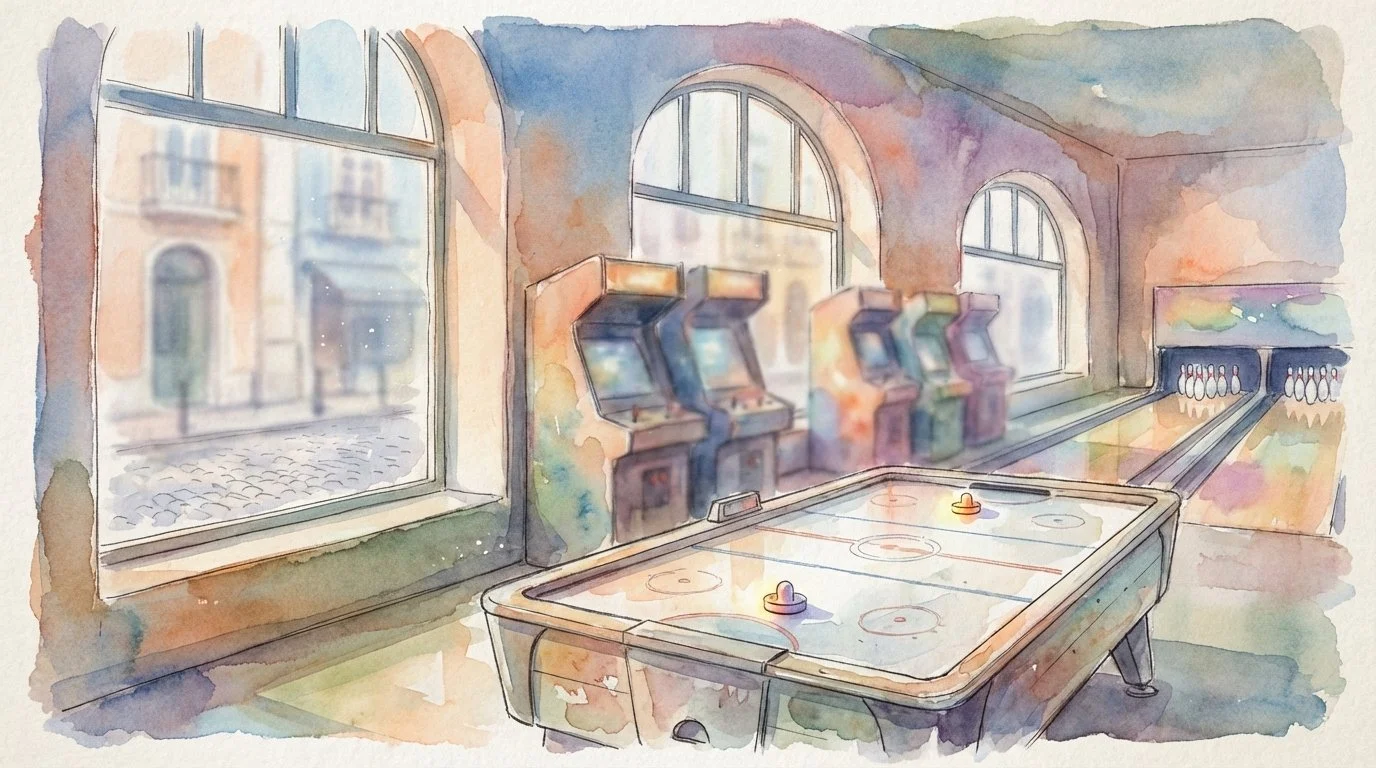
Last week in Lisbon, I found myself in an adult arcade with a good friend, trading the usual coffee catchup for bowling, air hockey and racing games.
Something about the flashing lights and the clatter of pins brought me right back to childhood. At one point, locked in a particularly intense air hockey match, I noticed something: I was winning with barely more than half the points.
The same pattern held in bowling. I'd win a game having only gotten 55% of the possible points for knowing down pins. My friend and I laughed about it, this low threshold where victory lived. Just over half felt like triumph. The rush was real, the satisfaction complete.
Driving home that night, I couldn't stop thinking about those percentages. Something about them nagged at me, a dissonance I couldn't quite name at first.
Then it hit me: in school, a 55% was failure. Not just mild disappointment, but genuine academic disaster. The emotions attached to that same number were completely opposite depending on context. At the arcade, I'd felt victorious. In a classroom, I would have been crushed.
This got me thinking about life's scorecards.
I've been actively investing in the stock market for past few years now, and recently I analyzed thousands of trades I have made. My win rate? 52%. That's it. Just barely over half.
And yet, I've beaten the market and have done relatively well. 52% has been more than enough.
If someone had told me at twenty that I'd one day celebrate 52%, I wouldn't have believed them. That number would have seemed like a mathematical expression of failure to any young person.
The pattern continued as I thought back further. Over fifteen years of running a tech company, I launched seven distinct product lines. Three of them failed completely, generating no lasting value. Only four succeeded, defined as still generating revenue a year after launch. Again, just over 50%.
And my business thrived and continues to today. Those failures didn't doom anything. They were simply part of the process of building products that did work well.
I started thinking about baseball, a sport I've never played but whose statistics I've always found confusing. A batting average in the .300s, meaning hitting the ball successfully 30% of the time, is considered good. If someone consistently bats .400, they're an all-star, a legend. A 40% success rate.
These numbers start to feel almost absurd when placed against my educational conditioning. To get into a competitive university program, I needed grades in the mid-90s. Anything below 80% was cause for concern, a sign something had gone wrong.
The disconnect is impossible to ignore. Children taught that 80% and 90% is the baseline for success, when so much of adult life operates on completely different mathematics. We demand near-perfection in environments where perfection is actually achievable, then are released into a world where it clearly isn't.
I cannot win 80% of the stock trades I make. I cannot achieve a 80% success rate as an entrepreneur with products I build. A baseball player cannot hit the ball 80% of the time. Regardless of the skill, intention, preparation or motivation. Reality doesn't work that way, and it does not need to. I can do just fine in life with a 55%.
This leaves me with two competing thoughts, neither of which feels entirely right but both of which feel important. Either we need to stop demanding perfection from young people, or we need to make school harder.
The first option feels more humane: adjust expectations, celebrate learning rather than flawless performance, acknowledge that mistakes are part of growth. But I'm not entirely convinced this is the answer.
The second option feels counterintuitive, even cruel at first glance. Make school harder so that 55% feels like success. Design systems where failure is normal, expected, built into the experience.
That's exactly what prepares someone for the texture of real life. We need to experience what 55% success feels like and have that sensation be positive, energizing, and worth celebrating.
I became an entrepreneur at twenty, and it remains one of the most valuable experiences of my life. Not because I succeeded at everything, far from it. But because it taught me very young to be comfortable with failure. I learned to hear "no" without crumbling. I learned that getting things wrong didn't mean I was wrong.
That education in failure built something in me I can't imagine living without now: resilience, humility, a realistic sense of what success actually looks like in practice rather than theory.
The arcade games gave me that same feeling, decades later. The pleasure of striving for 55%, of knowing that winning doesn't require domination or perfection. Just slightly better than half is enough.
I think about the emotional energy I wasted earlier in life, the anxiety that came from believing anything less than 90% meant I'd failed. How much of that was useful? How much of it prepared me for anything real?
I'm planning to go back to that arcade soon, probably next week. I'm looking forward to it in a way that feels important to honour. Not just for the fun, though it is fun. But for the reminder that success has different shapes, different percentages, different feels.
I'm grateful for every time I've learned this lesson: that winning means just barely more than losing, not being perfect. That four out of seven is plenty, that 52% can beat the market. These aren't consolations for mediocrity, they're the actual mathematics of building a life.
Maybe the real skill isn't achieving perfection. Maybe it's learning to recognize when 55% is not just enough, but genuinely something to celebrate.
And that is how I learned to fail.